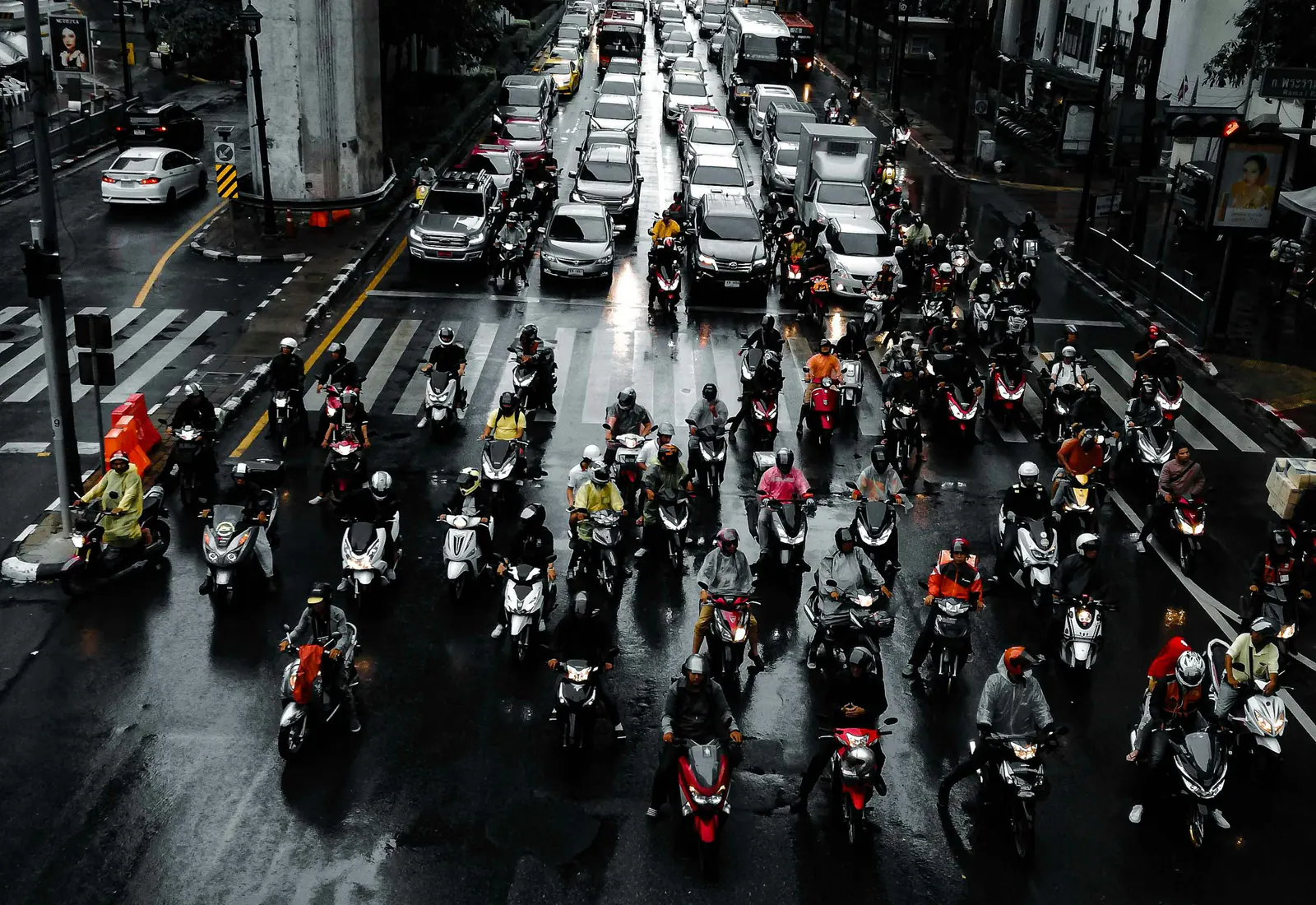
An automatic door slides open. Outside, the light feels much brighter. The air meets your face before you have quite finished stepping through the doorway. A scent that seemed unusually clear inside may suddenly feel different on the pavement: one detail comes forward, another recedes.
When a familiar fragrance feels different in another environment, the question isn't whether its formula has changed. It's what happens between our skin, the air and our sense of smell.
The liquid in the bottle is not what your nose receives
When you wear perfume, you don't smell the liquid in the bottle directly. You smell volatile molecules leaving your skin, moving through the air and eventually reaching your nose. Ingredients differ in their physical properties, so they are not all released at the same pace.
Researchers examine this process using headspace analysis: collecting and measuring aromatic vapours in the air above a surface. In a study modelling perfume diffusion from skin, Schwarzenbach and Bertschi identified temperature, the amount of fragrance on skin and ventilation as important parameters. More recent experimental work has measured fragrance release from skin, test strips and other model surfaces [1][2].
Heat can therefore alter the way a fragrance unfolds. It does not establish a universal rule that every perfume projects farther or disappears sooner whenever the temperature rises. Formula, dose, skin, location of application and moving air all matter.

The journey from street to air conditioning changes more than temperature
Outdoors, moving air can carry aromatic molecules away from the immediate space around your body. Indoors, a different pattern of ventilation can change how fragrance accumulates or disperses nearby, even when the room is cooler.
That is why moving between a sunlit street and an air-conditioned building is not a neat single-variable experiment. Temperature, airflow and often humidity shift together. A familiar fragrance can register differently for several reasons at once.
It also helps to separate two words often treated as interchangeable. Projection is the perceived reach of a scent around the wearer. Longevity concerns how long a fragrance can be noticed or detected. A louder opening does not, by itself, prove longer wear.
Does humidity make perfume stronger?
There isn't a useful one-line answer. In one controlled study, 50 healthy participants completed smell tests in warm, cold, dry and humid conditions. The researchers found no significant overall effect of temporary changes in temperature and humidity on the tested olfactory functions in that sample [3].
An earlier study, using different conditions and measurement approaches, found that humidity could affect odour-detection thresholds [4]. Neither study measured the projection of every finished perfume in tropical weather. Presenting either finding as “humidity always makes perfume stronger” would go beyond the evidence.
A more accurate distinction is that ambient conditions can influence how scent molecules travel and, in some circumstances, how we perceive odours. Humidity is not a universal volume control for fragrance.

Skin matters, but beware the easy explanations
Two people wearing the same formula may release different amounts of individual fragrance molecules from their skin. A 2025 study examined evaporation profiles across volunteers and explored both molecular characteristics and skin properties [5].
That does not allow anyone to predict an exact number of wearing hours from a simple label such as “dry skin” or “oily skin.” Earlier research also found relatively limited evidence of skin-mediated chemical transformation across many fragrance functional groups under clean, dry, non-forcing conditions [6]. Saying that an individual's skin pH simply “changes the entire perfume formula” is too sweeping.
How to test a fragrance for your actual day
You don't need an elaborate experiment or deliberate exposure to extreme heat. Use a paper strip to shortlist fragrances, then try one or two on un-irritated skin at comparable amounts. Notice the opening, then revisit how the scent feels as you continue your normal day.
If comparison matters, keep the variables you can control reasonably consistent: application area, number of sprays and similar surroundings. Treat your observations as personal experience, not laboratory measurements of projection or longevity.
And resist the temptation to equate loudness with quality. Nor does a fragrance have to be described as “fresh” to earn a place in someone's warm-weather wardrobe. Personal comfort and preference are part of the decision.
Perhaps a perfume does not need to defeat the heat
What we may want is something that still feels like ourselves between a bright pavement and a quiet meeting room, or between an evening commute and dinner. That experience cannot be judged from a list of notes alone.
ZCONY's fragrance descriptions include citrus, floral, woody and musky directions across its range. Sampling them in person can help someone discover what they enjoy; those note descriptions do not constitute measured evidence that one formula performs better than another in hot weather.
In the end, the most interesting change may not be in the perfume's identity. It may be in the relationship between the liquid on our skin, the air around us and the person experiencing it.
Research notes and sources
[1] Schwarzenbach, R. and Bertschi, L. (2001), Models to assess perfume diffusion from skin, International Journal of Cosmetic Science. https://pubmed.ncbi.nlm.nih.gov/18498453/
[2] An innovative device for in vivo and in vitro study of fragrance evaporation after application on skin or model surfaces, Talanta (2025). https://pubmed.ncbi.nlm.nih.gov/39265418/
[3] The sense of smell is not strongly affected by ambient temperature and humidity: a prospective study in a controlled environment (2020). https://pubmed.ncbi.nlm.nih.gov/33094385/
[4] Changes of pressure and humidity affect olfactory function (2008). https://pubmed.ncbi.nlm.nih.gov/17901967/
[5] Exploring the impact of fragrance molecular and skin properties on the evaporation profile of fragrances (2025). https://pubmed.ncbi.nlm.nih.gov/40524649/
[6] Insight into how skin changes perfume (1996). https://pubmed.ncbi.nlm.nih.gov/19245452/
ZCONY product terminology checked against internal 01A/01C (20 Oct 2026). Illustrative settings and suggested personal trials are not controlled tests of any ZCONY formula. Comparative hot-weather performance data for the ten ZCONY fragrances are unavailable.
Image credits and rights
The three editorial photographs are used under the Unsplash License. Images were resized and converted to WebP for web presentation; they are not scientific experiment records.
Leonardo Gasparini · Unsplash source
Ratapan Anantawat · Unsplash source
Blake Wisz · Unsplash source
License: Unsplash License